Barracuda Patches Flaw Chain That Can Give Attackers Root on ESG
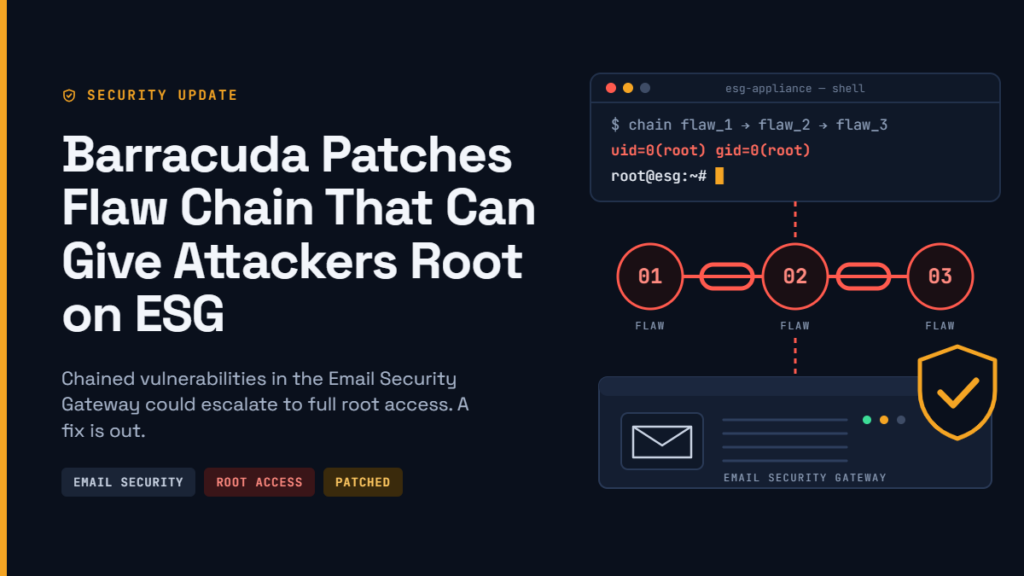
Barracuda has fixed two flaws that, chained together, can give an attacker root control of its Email Security Gateway. Several other Barracuda appliances share one of the bugs.

In this article
This alert is for IT administrators, managed service providers and business owners who run Barracuda security appliances, especially the Email Security Gateway (ESG) that filters company email. On 2 November 2026, Barracuda released fixes for two vulnerabilities that, used together, could give an attacker full root control of an ESG appliance. One of the two flaws also affects five other Barracuda products.
Key takeaways
- CVE-2026-116606 is an authorisation bypass in the ESG web management interface, rated 9.3 by Barracuda.
- CVE-2026-111560 is a command injection flaw rated 8.6 that affects ESG, Load Balancer ADC, Message Archiver, WAF Control Center, Web Application Firewall and Web Security Gateway.
- Chained together, the two flaws can lead to root access on ESG.
- No active exploitation or public exploit code had been reported at the time of writing, but ESG has been targeted quickly in the past.
- Patch now and keep the management interface off the public internet.
What Barracuda fixed
CVE-2026-116606: configuration restore without logging in
According to Barracuda’s advisory and an analysis by Beazley Security Labs, this flaw lets an unauthenticated attacker reach a configuration-import function in the ESG administrative interface and restore a crafted backup file. That overwrites the device’s global settings without needing a password. Only the Email Security Gateway is affected by this bug.
CVE-2026-111560: commands hidden in the timezone field
The second bug is an operating system command injection flaw in the timezone setting, in code shared across several Barracuda appliances. On its own it requires administrator access, but a malformed timezone value can make the device run shell commands as root. The flaws were reported by Mandiant researchers, according to SecurityOnline.
Why the chain matters
Combined, the first flaw can give an attacker the administrative foothold needed to trigger the second, which results in full root control of the appliance. Barracuda notes that exploitation requires access to the administrative interface, which is why internet-exposed management pages are the biggest worry. SecurityOnline reports that Shodan searches show thousands of Barracuda management portals reachable from the public internet.
Affected products and patches
Barracuda lists the following patches. Beazley Security Labs lists the affected version ranges.
- Email Security Gateway (ESG): versions before 9.4.0.030 are affected by both flaws. Patch BNSF-40425 applies to 9.4.017 and later; BNSF-40430 applies to earlier versions. Upgrading to 9.4.0.030 or later addresses both CVEs.
- Load Balancer ADC: versions before 6.4.0, patch BNADC-16586.
- Web Application Firewall (WAF): versions before 11.0.1, patch BNADC-16586.
- Web Security Gateway (WSG): versions before 16.1.100.100, patch BNYF-24789.
- Message Archiver (BMA): versions before 5.5.4.0, patch BNMA-32468.
- WAF Control Center (WCC): versions before 2.2.1, patch BNWF-60060.
Barracuda says patches that were not applied automatically should be installed manually as soon as possible, and that devices several versions behind may need more than one update to reach a fixed release.
Is it being exploited?
Barracuda’s advisory does not state that the flaws are being exploited, and Beazley Security Labs and SecurityOnline reported no active attacks and no public proof-of-concept code at the time of writing. That is good news, but it is not a reason to wait. Beazley points out that ESG appliances have historically been attacked soon after flaws become known, citing the 2023 campaign in which a group tracked as UNC4841 exploited earlier ESG zero-days. Email gateways see every message entering a company, which makes them valuable targets for spies and fraudsters alike.
Why this matters for African businesses
Email remains the main channel for invoices, payment instructions and supplier communication for many Nigerian and African companies. An attacker in control of the email gateway could, in principle, read, alter or redirect sensitive messages, which is exactly what business email compromise and invoice fraud depend on. Organisations that rely on a managed service provider for their Barracuda appliances should confirm that the provider has applied these patches, rather than assuming it has been done.
What you should do
- List your Barracuda appliances. Include ESG, WAF, Load Balancer ADC, Message Archiver, Web Security Gateway and WAF Control Center, whether physical or virtual.
- Check firmware versions. Each device shows its current version and the latest version available. Compare it with the affected ranges above.
- Apply the patches. Install the patch listed for each product, manually if it was not applied automatically. Follow the product-specific steps on Barracuda Campus.
- Turn on automatic patching. Barracuda recommends enabling it if it is switched off.
- Lock down the admin interface. Restrict web administration to trusted internal networks or a VPN, and block access from the public internet with firewall rules.
- Review recent changes. Look for unexpected configuration restores, new admin accounts or changed timezone settings, and contact Barracuda support if anything looks wrong.
- Ask your provider. If a partner manages your appliances, ask for written confirmation that the November 2026 fixes are installed.
Sources
- Barracuda Trust Center: Pre-Authentication Authorization Bypass and Command Injection Vulnerabilities
- Beazley Security Labs advisory BSL-A1240
- SecurityOnline: Barracuda patches critical authorization bypass and command injection flaws
Featured image: Photo: “Mediq Utrecht Data center Gwan Kho” by Gwan Kho, CC BY-SA 2.0, via Openverse — source
Was this article helpful?

adminVerified expert
Cybersecurity Analyst
Federal Capital Territory (Abuja)
Credentials: MCPN, MNCS, IAENG | System Analyst · Web Developer · CEH · CC · CDST
Got expertise to share? Write for us →