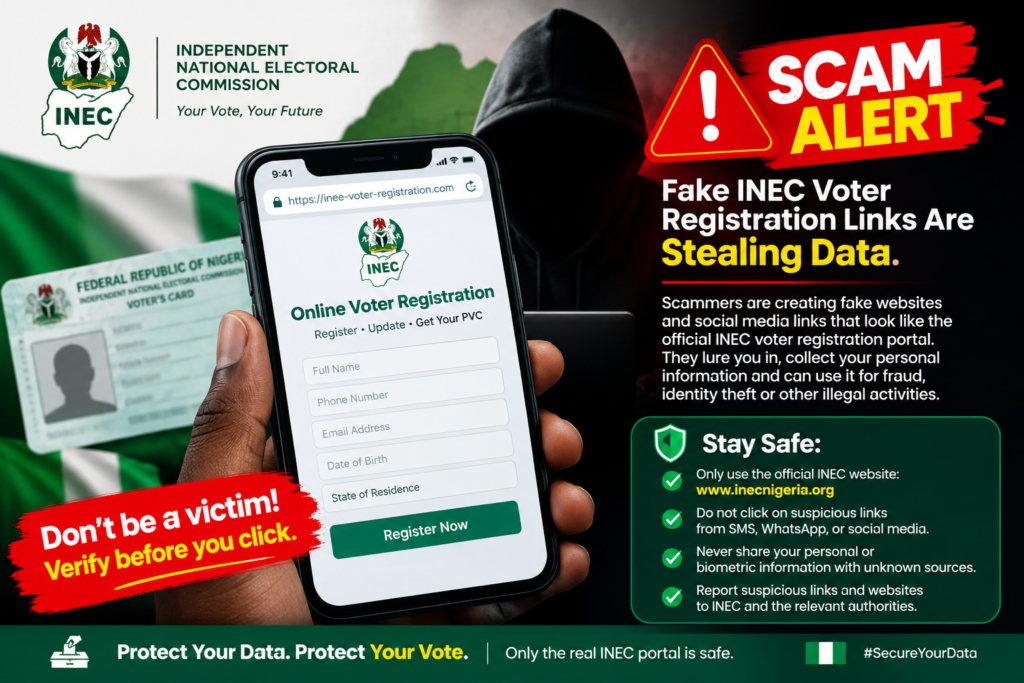
Scam Alert: Fake INEC Voter Registration Links Are Stealing Data
Links claiming to offer online voter registration and home PVC delivery are circulating on WhatsApp and social media. INEC says they are fake. Here is how the scam works and how to protect yourself.

In this article
With the 2027 general elections approaching, many Nigerians who missed voter registration are looking for a second chance. Scammers know this. Fake “online voter registration” links promising easy sign-up and home delivery of Permanent Voter Cards (PVCs) are spreading on WhatsApp and social media, and the Independent National Electoral Commission (INEC) says they are designed to steal personal information. This alert explains how the scam works and what to do.
What INEC has said
On 3 October 2026, INEC disowned a fraudulent online voter registration portal and confirmed that the nationwide Continuous Voter Registration (CVR) exercise ended on 26 July 2026, after an extension. The fake site claimed INEC had announced a new online registration window running from 28 September to 27 October 2026. INEC says no such exercise exists.
The link being shared used a URL shortener made to look official, with the words “inecnigeria” and “cvr” in it. INEC said it is not affiliated with the Commission and warned people not to click it or submit any details.
INEC’s Deputy Director of Information and Publicity, Wilfred Ifogah, told the News Agency of Nigeria that the site was built to harvest personal data and that clicking it could expose users to identity theft and cyber fraud. INEC also stressed that it does not use third-party blog links or private URLs for official exercises, and it does not deliver PVCs to people’s homes.
A recurring trick
This is not new. INEC warned about a similar fake online PVC registration portal in 2022, which claimed the government had approved online registration to ease crowding. The details change each time, but the hook stays the same: an easy, official-looking shortcut to a voter card.
How the scam works
- The bait: a message with a headline such as “INEC online voters registration 2026 ongoing” arrives on WhatsApp, Facebook or X, often forwarded by friends or family who believe it is genuine.
- The pressure: it gives a deadline, which varies between versions of the message, to push you to act before you think. One version claimed registration would close on 17 August 2026, even though the real exercise had already ended in July.
- The lure: it promises that your PVC will be delivered to the home address you enter.
- The trap: the link opens a site on an unrelated domain. Fact-checkers at DUBAWA found one such domain had been registered in July 2025, well before the claimed exercise.
- The harvest: the form asks for personal details such as your name, date of birth, phone number, home address and identity numbers. That information can be sold, used for SIM swap and bank fraud, or used to make follow-up scams more convincing.
Warning signs
- The link is shortened or does not end in inecnigeria.org.
- The message promises home delivery of your PVC. INEC does not do this.
- It announces a registration window you cannot find on INEC’s official website or verified social media accounts.
- It uses urgent language and a countdown deadline.
- It asks you to forward the message to groups to “help others register”.
- The form asks for bank details, BVN, card numbers or one-time passwords. No voter registration process needs these.
How to protect yourself
- Use only official channels. INEC’s voter registration portal is cvr.inecnigeria.org and its website is inecnigeria.org. You can also call 0700-CALL-INEC (0700-2255-4632) or check INEC’s verified social media accounts.
- Know the timeline. INEC’s spokesperson told the BBC that anyone who missed the deadline will have to wait until after the 2027 general elections for another registration exercise.
- Do not forward unverified links. Check first, then share the correction instead.
- Protect your accounts. Set a SIM PIN with your network, use strong unique passwords and turn on two-step verification for WhatsApp, email and banking apps.
- Brief your team and family. Businesses should warn staff, since a single shared link in a work group can expose many people.
If you already clicked or entered details
- If you only opened the link, close it and do not return. Clear the page from your browser history.
- If you entered personal details, watch your bank accounts and phone line closely for unusual activity, and tell your bank so it can flag your account.
- Change passwords for any accounts linked to the phone number or email you entered.
- Be suspicious of any follow-up calls or messages claiming to be from INEC, your bank or the police that ask for codes or payments.
- Report the incident to INEC through its official channels and to the police. You can also report cybercrime to the Nigeria Police Force National Cybercrime Centre.
What you should do
Treat any message about voter registration, PVC delivery or election jobs as unverified until you confirm it on inecnigeria.org or through INEC’s call centre. Share this alert in your family and work WhatsApp groups, and remind people that a real INEC service will never ask for bank details or deliver a PVC to their door. As the 2027 elections get closer, expect more fake election-themed links, and make checking the source a habit.
Sources
Have you come across this scam?
Was this article helpful?

adminVerified expert
Cybersecurity Analyst — 20 years experience
Federal Capital Territory (Abuja)
Credentials: MCPN, MNCS, IAENG | System Analyst · Web Developer · CEH · CC · CDST
Got expertise to share? Write for us →