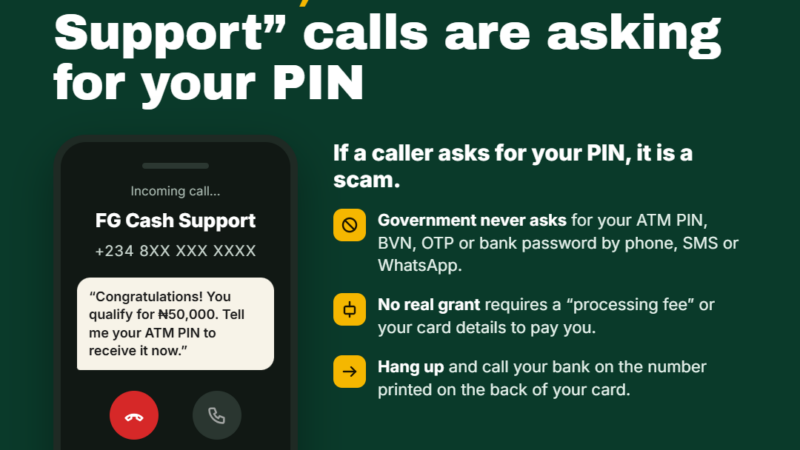
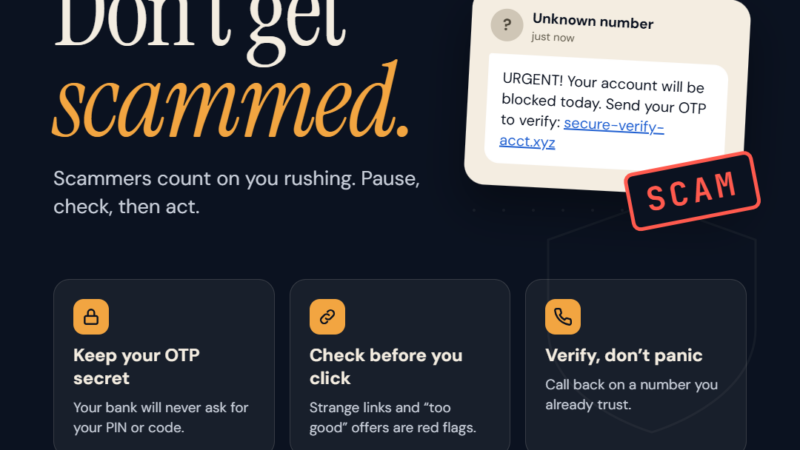
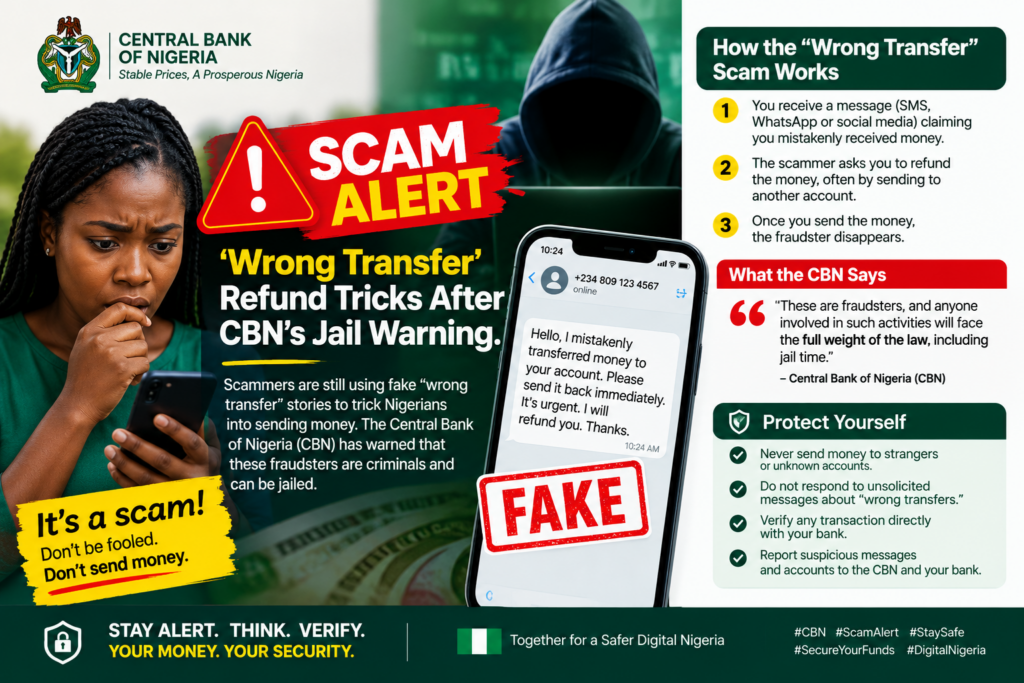
Scam Alert: ‘Wrong Transfer’ Refund Tricks After CBN’s Jail Warning
The CBN has warned that knowingly keeping money sent by mistake can lead to jail. Fraudsters use that fear in fake 'wrong transfer' refund scams. Here is how to respond safely.

In this article
On Thursday, 22 October 2026, the Central Bank of Nigeria (CBN) used its CBN Listens stakeholders’ meeting in Ibadan to deliver a blunt message: customers who knowingly refuse to return money sent to their accounts by mistake could face five to ten years in prison. The warning, delivered on behalf of Governor Olayemi Cardoso by CBN spokesperson Hakama Sidi Ali, also urged Nigerians not to share personal or banking details with fraudsters. This alert is for every bank, fintech and mobile money user, and especially for traders and small businesses that receive many transfers a day.
The warning is a fair reminder of the law. But it also hands fraudsters a fresh script. The “wrong transfer” refund trick works precisely because people are afraid of being accused of keeping money that is not theirs.
Key takeaways

- Money sent to you by mistake is not yours, and you should help return it, but only through your bank.
- Scammers send a real or fake credit, then pressure you to “refund” it directly, often to a different account and sometimes with extra fees.
- Returning money yourself can make you a link in a money-laundering chain or leave you paying twice.
- If you sent money to the wrong account, call your own bank first and act immediately.
How the wrong-transfer scam works
- The credit arrives. You receive an unexpected transfer, or just an SMS or screenshot claiming one. Sometimes the money is real and came from another fraud victim.
- The call or message follows. Someone says they sent it by mistake: school fees, a hospital bill, money for a sick parent. The story is designed to create sympathy and urgency.
- The pressure builds. They mention the CBN warning, police or EFCC, or threaten to have your account blocked if you do not send it back immediately.
- The redirect. They ask you to send the money to a different account, a mobile wallet or a payment link, not back to the original sender. Some add “interest” or “processing fees”.
- The sting. If the original credit was fake, you have just paid a stranger. If it was stolen money, the real victim’s bank may later reverse the credit from your account, and you lose the amount twice. Your account may also be flagged in a fraud investigation.
Variations to watch for
- Overpayment scams: a “customer” or “employer” pays more than agreed and asks you to refund the difference to another account.
- Fake alert plus refund: a forged credit SMS, with no money in your balance, followed by a desperate refund request.
- Fake bank staff: someone posing as your bank’s customer care asks for your card details, PIN or OTP to “process the reversal”.
Warning signs
- The person contacts you directly instead of going through their own bank.
- They want the refund sent anywhere other than the exact account it came from.
- They add charges, interest or penalties to the amount.
- They rush you, threaten arrest or account blocking, or change their story.
- They ask for your BVN, PIN, OTP or internet banking login.
- The “credit” appears in an SMS but not in your actual account balance in the app.
How to protect yourself
If you receive money you were not expecting
- Check your real balance in your bank app or by calling your bank. Do not trust the SMS or a screenshot alone.
- Do not spend, withdraw or move the money. Leave it untouched.
- Do not send it back yourself, even to the original account, and never to a new one.
- Call your bank using the number on its official app, website or your card, not a number the caller gives you. Tell them about the credit and the refund request.
- Let the banks handle it. Sign any reversal forms your bank provides. This is how you comply with the CBN’s warning safely.
- Keep evidence: screenshots of the alert, call logs, chat messages and the transaction reference.
If you sent money to the wrong account
- Call your own bank immediately with the time, amount and account details. Most Nigerian transfers clear instantly, so speed matters.
- Your bank contacts the receiving bank, which can place a Post-No-Debit restriction on the disputed amount while the matter is resolved.
- If the recipient refuses to cooperate, your bank can advise on the next steps, which may include a police report, a sworn affidavit and a court order.
- To avoid mistakes, always check the account name displayed before confirming, delete old payees you no longer use, and send a small test amount before large payments.
Advice for businesses
Shops, distributors and service businesses are frequent targets because they receive many transfers. Make it a written rule that no staff member refunds any “wrong transfer” or “overpayment” directly. All such cases go to the business owner or finance lead, who contacts the bank. Train cashiers to confirm payments in the bank app, never from an SMS or screenshot shown by a customer.
What to do if you are a victim
- Contact your bank at once with all details of the transfer you made and the account you sent it to.
- Report the incident to the police, including the Nigeria Police Force National Cybercrime Centre (NPF-NCCC).
- If your bank does not resolve your complaint within the stipulated time, escalate it to the CBN’s Consumer Protection and Financial Inclusion Department.
- Ignore anyone who offers to “recover” your money for a fee. That is usually a second scam.
What you should do
Share this with family members and staff who handle payments. The safe rule is simple: an unexpected credit is a matter for your bank, not for the stranger on the phone. Return money only through official bank channels, and never send it to a new account.
Sources
Have you come across this scam?
Was this article helpful?

adminVerified expert
Cybersecurity Analyst — 20 years experience
Federal Capital Territory (Abuja)
Credentials: MCPN, MNCS, IAENG | System Analyst · Web Developer · CEH · CC · CDST
Got expertise to share? Write for us →