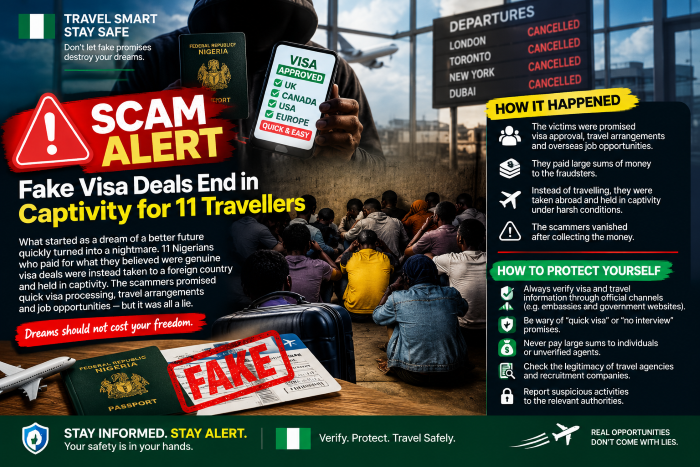
Scam Alert: Fake Visa Deals End in Captivity for 11 Travellers
Police in Ogun State rescued 11 Ghanaians who paid for promised Canadian and Spanish visas and were held captive. Here's how fake visa offers work and how to stay safe.

In this article
- Key takeaways
- What happened in Sagamu
- How the fake visa scam works, step by step
- The link to human trafficking
- Warning signs to watch for
- How to protect yourself
- Verify through official channels only
- Protect your documents and data
- Tell someone you trust
- Frequently asked questions
- Can an agent really speed up my visa?
- The agent is someone I know. Is it still risky?
- What if I’ve already paid?
- What you should do
- Sources
Eleven Ghanaians who each paid GH¢40,000 for promised Canadian and Spanish visas ended up held captive in Sagamu, Ogun State, until police rescued them on October 19. The case shows how a “visa agent” offer can turn from fraud into something far more dangerous. This alert is for anyone in Nigeria or elsewhere in West Africa considering work or study abroad, and for parents, HR teams and community leaders who advise them.
Key takeaways
- Police say a fellow Ghanaian lured the victims with promises to arrange visas for Canada and Spain, then they were brought to Nigeria and held against their will.
- Canada’s immigration department says no consultant or individual can guarantee a visa, job or permanent residency.
- Official visa fees are never paid into personal bank accounts, through gift cards or through private money transfers.
- Nigeria’s anti-trafficking agency, NAPTIP, warns that traffickers increasingly use fake job offers and online scams to recruit victims.
- Verify every offer through official embassy or government websites before you pay anything or travel anywhere.

What happened in Sagamu
In a statement issued on October 20, the Ogun State Police Command said operatives of its Anti-Kidnapping Unit acted on intelligence received on October 19 and located a hideout in Sagamu. They rescued seven men and four women, all Ghanaian nationals. According to police, the victims had each paid GH¢40,000 after a fellow Ghanaian promised to arrange their travel to Canada and Spain. Instead of receiving visas, they were taken to Nigeria and confined.
Ghana’s state broadcaster GBC reported that no one was hurt in the rescue and that detectives are working with Ghanaian security agencies to trace the main suspect and local collaborators. No arrests had been reported at the time of writing. The report also noted that groups like this often hold victims to demand more money from their families. The Ogun police commissioner, Bode Ojajuni, praised the unit’s response, and police urged the public to verify overseas travel and visa arrangements before paying anyone.
How the fake visa scam works, step by step
- The approach. The “agent” is often someone you know, a friend of a friend, a church or community contact, or a stranger on social media advertising “guaranteed” visas and jobs abroad.
- The promise. You’re told the visa is certain, sometimes with a job, accommodation or a fast-track arrangement thrown in. Popular destinations include Canada, the UK and European countries.
- The payment. Large sums are collected, usually in cash or by transfer to a personal account. Receipts are missing or look homemade.
- The delay or detour. Victims are told to travel to another city or country “for processing” or to catch a connecting flight.
- The trap. In the worst cases, as in Sagamu, victims are confined and their families are pressured for more money. In others, the agent simply disappears with the payment, or victims are trafficked into forced work, including scam centres.
The link to human trafficking
At a briefing in July, NAPTIP’s Director-General Binta Adamu-Bello said traffickers use fake job offers and online scams to recruit and exploit victims, often through social media and encrypted messaging apps. The agency reported rescuing 156 victims of cyber-enabled trafficking between January and July 2026, after more than 300 in 2025.
Warning signs to watch for
- A guarantee that your visa will be approved. Only immigration officers make that decision.
- Unsolicited offers through WhatsApp, Facebook, TikTok or other social media.
- Requests for cash, payment into a personal account, gift cards or money transfer services.
- No proper receipt, contract or verifiable office address.
- Pressure to pay quickly or keep the arrangement secret from family.
- Instructions to travel to another city or country before you have seen a real visa.
- Requests to send your passport or ID documents over social media.
- Threats that your application will fail or you’ll be deported unless you pay an “outstanding fee” immediately.
How to protect yourself
Verify through official channels only
- Use the official immigration website of the country you want to visit. Canada, for example, says its government website is the only official source of information on its immigration programmes.
- Pay visa fees only through the official government payment system or the officially appointed visa application centre, never to an individual.
- If you use an immigration consultant, check that they are licensed with the regulator in the destination country.
Protect your documents and data
- Never hand over your passport to an agent who is not an official visa centre.
- Don’t share passport scans, BVN or NIN details through social media chats.
- Keep copies of all messages, receipts and account numbers in case you need to report.
Tell someone you trust
Before you travel for any “processing”, tell family where you are going, who you are meeting and how to reach you. Scammers rely on secrecy.
Frequently asked questions
Can an agent really speed up my visa?
No legitimate agent can guarantee approval. Licensed representatives can help you prepare forms, but the decision belongs to the immigration authority.
The agent is someone I know. Is it still risky?
Yes. In the Sagamu case, police say the victims were lured by a fellow Ghanaian. Familiarity lowers people’s guard, which is exactly what scammers count on.
What if I’ve already paid?
Stop all further payments, gather your evidence and report quickly. The sooner banks and police know, the better the chance of tracing funds.
What you should do
- Treat any “guaranteed visa” or “job abroad with visa included” offer as a scam until proven otherwise on an official government site.
- Never travel to another city or country for “visa processing” arranged by an individual.
- If you’ve been targeted or paid money, contact your bank immediately and report to the Nigeria Police Force, and to NAPTIP if trafficking may be involved.
- If you suspect someone is being held against their will, contact the police at once.
- Share this alert with young job seekers and students in your family, church, mosque or workplace.
Sources
- Nigeria police rescue 11 Ghanaians in alleged GH¢40,000 visa scam – Citi Newsroom
- 11 Ghanaians rescued in Nigeria after paying GH¢40,000 each in visa scam – GBC
- Fake visa scam: 11 Ghanaians rescued from captivity in Nigeria – 3News
- Canada reveals how to spot visa application fraud – ProPakistani
- NAPTIP warns of rising online scams linked to human trafficking – NAN
Featured image: Photo: “Passport photo (1992)” by Mike Knell, CC BY-SA 2.0, via Openverse — source
Have you come across this scam?
Was this article helpful?

adminVerified expert
Cybersecurity Analyst — 20 years experience
Federal Capital Territory (Abuja)
Credentials: MCPN, MNCS, IAENG | System Analyst · Web Developer · CEH · CC · CDST
Got expertise to share? Write for us →