ChatGPT Now Lets Businesses Claim Profiles: What SMEs Should Know
OpenAI's new Businesses in ChatGPT beta lets companies claim verified profiles and launch their own AI agents. Here is how it works, who can use it now, and how African SMEs can prepare.

In this article
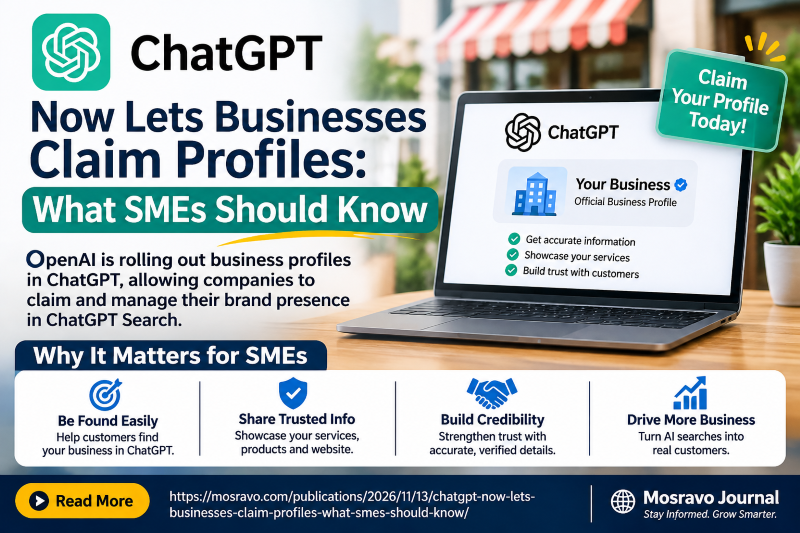
More customers now ask AI assistants, not search engines, questions like “where can I buy a solar inverter?” or “which accounting software suits a small shop?”. OpenAI has responded with a new beta called Businesses in ChatGPT, announced on 10 November 2026, that lets companies claim and manage how they appear inside ChatGPT and even run their own AI agent there.
This article explains what was launched, who can use it today, and practical steps small and medium businesses, including those in Nigeria and across Africa, can take now, without the hype.
Key takeaways
- Businesses in ChatGPT has two parts: a Business Hub for claiming and managing a verified profile, and Business Agents that answer customer questions on a company’s behalf.
- Business Agents are available first to eligible ecommerce and online service businesses in the United States. OpenAI says it plans to expand to more markets and business types.
- Businesses get aggregated insights, such as how often they are mentioned and common topics, but cannot see individual users’ chats.
- Even if you cannot join yet, the launch is a signal: accurate, consistent business information online will matter more as AI assistants recommend products.
What OpenAI launched
Business Hub: claim and manage your profile
According to PYMNTS, companies can use Business Hub to claim and verify their profile, update business information, and supply product feeds with pricing and availability. Shopify merchants can connect their stores through Business Hub or from Shopify’s own admin, and eligible Shopify products are already integrated through Shopify Catalog.
Let’s Data Science, citing The Verge and OpenAI’s help centre, reports that verification can use a phone number, business email, website domain or Shopify, and that identity verification through Persona is required before a business can publish changes, see insights or create a Business Agent.
Business Agents: an AI that speaks for your brand
Once a profile is claimed, an eligible business can build, test and launch an agent that answers questions about its products and services. When ChatGPT mentions that business in a response, a user can open the profile and start a separate conversation with the business’s agent, for example to compare two products. These agent chats are clearly labelled and kept apart from the user’s main ChatGPT conversation. Businesses write the agent’s instructions and provide the business context; OpenAI controls the labelling and separation.
Insights, with privacy limits
Businesses can see aggregated data such as how often they are mentioned in ChatGPT responses, website clicks, and the top topics in which they appear. They cannot read individual user conversations or chats with their agent, and data is only shown once activity reaches certain thresholds.
Who can use it now
For now, Business Agents are limited to eligible US ecommerce and online service businesses, subject to OpenAI’s industry, location and integrity checks. OpenAI has said it will add more markets and categories over time, but has not given dates. Reports we reviewed did not mention pricing for the beta.
That means most Nigerian and African SMEs cannot launch an agent yet. It is still worth understanding, because the way AI assistants find and describe businesses is changing quickly.
Why it matters for African SMEs
- Discovery is shifting. If customers ask ChatGPT for recommendations, being described accurately there becomes part of your marketing, much like a Google Business Profile today.
- Wrong information spreads. AI assistants build answers from what they can find online. Outdated prices, old addresses or closed branches can be repeated to customers.
- Impersonation risk. Verified profiles should, in time, make it easier for customers to tell your real business from fake pages, which matters in markets where cloned business pages are a common scam.
How to prepare now
- Clean up your public information. Make sure your website, Google Business Profile and social pages share the same name, address, phone number, opening hours and product range.
- Publish clear product pages. Plain descriptions, specifications, prices and availability make it easier for any AI tool to describe your offer correctly.
- Use a business email on your own domain. Verification options include a business email and website domain, so a generic free email address may slow you down later.
- Write an FAQ page. Answer the questions customers actually ask about delivery, returns, warranties and payment. This content is also what you would feed an agent.
- Check what ChatGPT says about you. Ask it about your business and products and note any errors you need to correct at the source, on your own pages.
- If you sell on Shopify, watch your Shopify admin for the ChatGPT connection option as availability expands.
Risks and things to watch
- Accuracy: an AI agent that gives a wrong price or promise could create customer disputes. Test thoroughly and keep instructions tight.
- Dependence: do not build your whole sales strategy on one platform’s beta; keep your website and direct channels strong.
- Scams: expect fraudsters to offer to “get you verified on ChatGPT” for a fee. Verification is done through OpenAI’s own Business Hub; be wary of anyone selling shortcuts.
Next steps
- Spend an hour this week making your business information consistent across your website and listings.
- Draft a simple FAQ and product information sheet you could reuse for any AI assistant.
- Keep an eye on OpenAI’s announcements for expansion beyond the US before planning budget or staff time for a Business Agent.
Sources
- PYMNTS: OpenAI Gives Businesses New Tools to Reach ChatGPT Users
- Let’s Data Science: OpenAI launches verified Business Agents in ChatGPT beta
- RuntimeWire: OpenAI lets businesses claim their ChatGPT listing and build their own agent
Featured image: Photo: “Online Shopping FTW!” by dahon, CC BY-ND 2.0, via Openverse — source
Was this article helpful?

adminVerified expert
Cybersecurity Analyst — 20 years experience
Federal Capital Territory (Abuja)
Credentials: MCPN, MNCS, IAENG | System Analyst · Web Developer · CEH · CC · CDST
Got expertise to share? Write for us →