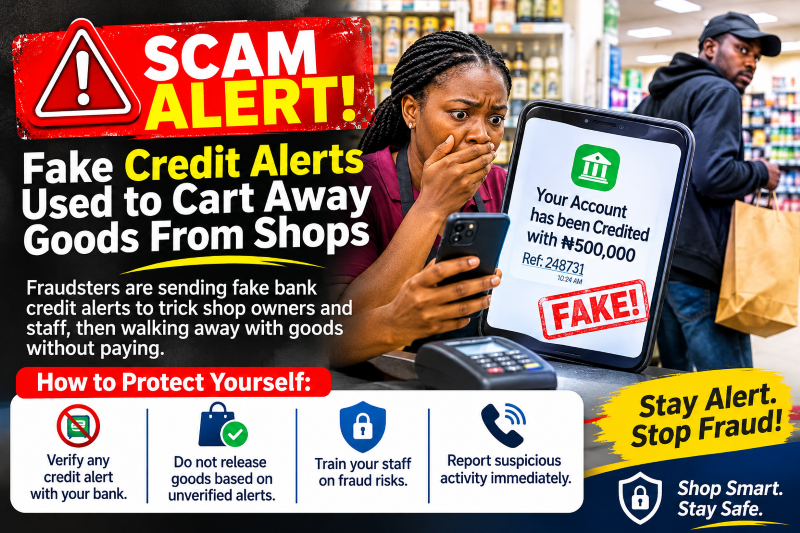
Scam Alert: Fake Credit Alerts Used to Cart Away Goods From Shops
Fraudsters are posing as customers, sending fake bank alerts or transfer receipts, and leaving with goods before the trader notices no money arrived. Here's how the trick works and how to protect your business.

In this article
If you sell goods or services and accept bank transfers, this alert is for you. Police in Bauchi State say two men posing as genuine customers walked into a shop, picked out electronics worth about ₦3 million and “paid” by showing the owner a fake bank alert. By the time the trader realised no money had arrived, they were gone. The case, announced this month, is a reminder that a text message or screenshot is not money in your account, especially in the busy festive trading season.
The Bauchi case
According to the Bauchi State Police Command’s spokesperson, Nafiu Habib, the incident happened on 26 October 2026. Two men visited a 65-year-old businessman’s shop at Fire Service Junction, Bauchi, and bought televisions, a sound bar, two air conditioners and a home theatre system. They sent a fake bank alert as proof of payment and left.
The trader reported the matter on 30 October. Detectives arrested one suspect, and police say all the items were later recovered, partly in Jos, Plateau State. A second suspect is still being sought. The police used the case to urge business owners to confirm payments with their banks before releasing goods and to report suspicious transactions quickly.
Not every victim is so lucky. In most cases, goods released against a fake alert are never seen again.
How the fake alert scam works
- The approach: the fraudster behaves like a normal, even generous, customer. They may buy in bulk, avoid haggling, or arrive when the shop is busy or about to close.
- The “payment”: they claim to transfer the money and then show a convincing SMS, email, WhatsApp message, receipt or payment-success screen. Some use apps that generate fake alerts complete with sender name, account number, amount, reference number and date.
- The excuse: if the money is not in your account, they blame network problems, bank maintenance or a weekend delay, and insist it will “drop soon”.
- The pressure: they hurry you, often loading the goods quickly or claiming they have another appointment.
- The exit: once the goods are released, they disappear. Phone numbers often stop working.
Some fraudsters skip the fake message and use social engineering instead, for example pretending to call from your bank to “confirm” the transfer, or sending a link asking you to log in and check it.
Warning signs to watch for
- The customer relies on a screenshot, SMS, email or printed receipt as proof of payment.
- The amount does not appear in your banking app or account statement.
- The alert arrives from an unfamiliar number or contains spelling errors or odd formatting.
- The buyer pushes you to release goods immediately and gets irritated when you want to check.
- Someone “from the bank” calls or texts to confirm the payment, or asks for your PIN, OTP or password.
- You receive a link asking you to “view” or “accept” an incoming transfer.
Why it keeps working
Digital payments are now normal for most Nigerian businesses, from PoS operators to electronics dealers. Data from the Nigeria Inter-Bank Settlement System (NIBSS), reported in August, showed that banks and financial institutions lost ₦25.85 billion to digital payment fraud in 2025, down from ₦52.26 billion in 2024, with about 67,518 reported cases. NIBSS named social engineering as the most common fraud technique. Fake alerts are a form of social engineering: they exploit trust, busy shops and the reasonable assumption that a professional-looking message is real.
Bank communications professionals have also raised concerns. Jide Sipe, president of the Association of Corporate Communication and Marketing Professionals in Banks (ACAMB), warned this month that fake bank alerts, cloned websites and impersonation accounts are becoming harder to tell apart from genuine messages, and urged customers to pause and verify through official channels.
How to protect yourself and your business
Confirm every payment the right way
- Open your official banking app or internet banking and check the balance or transaction history yourself before releasing goods.
- Never accept a screenshot, forwarded SMS or receipt as proof of payment.
- If the money has not arrived, the goods stay. Politely ask the customer to wait or come back.
- For large sales, consider asking for payment a day ahead, or using a payment method that confirms instantly to you.
Set clear shop rules
- Put up a notice: “Goods are released only after payment is confirmed in our account.”
- Train staff, including sales attendants and PoS operators, to follow the rule every time, even for regular customers.
- Have one trusted person confirm transfers, and give them app notifications from the bank, not from customers’ phones.
Guard your own banking details
- Never share your PIN, password, OTP, CVV or BVN. As ACAMB’s president put it, no bank in Nigeria will ask you to confirm these through a link.
- Do not click links in messages about incoming payments. Use only your bank’s app or its published customer service numbers.
- Turn on two-factor authentication on your banking app.
What to do if you are a victim
- Contact your bank immediately through its official channels and ask whether any transfer was attempted.
- Report to the nearest police station with the suspect’s phone number, any messages, CCTV footage and descriptions.
- Keep every screenshot, receipt and message the fraudster sent as evidence.
- Warn your market association or trader groups so others can watch out for the same people.
What you should do
Make “check the app before releasing goods” a non-negotiable rule for everyone who serves customers in your business. Share this alert with your staff and fellow traders, especially ahead of the end-of-year rush, when busy shops make fake alerts easier to slip through.
Sources
- Police arrest man over fake alert, recover N3m goods in Bauchi (Dateline Nigeria)
- Fake Bank Alerts: How Nigerians Can Detect and Avoid Payment Scams in 2026 (Legit.ng)
- ACAMB warns bank customers against phishing scams and cyber fraud (Opinion Nigeria)
Featured image: Photo: “Smartphone” by Insights Unspoken, CC BY-SA 2.0, via Openverse — source
Have you come across this scam?
Was this article helpful?

adminVerified expert
Cybersecurity Analyst
Federal Capital Territory (Abuja)
Credentials: MCPN, MNCS, IAENG | System Analyst · Web Developer · CEH · CC · CDST
Got expertise to share? Write for us →