Scam Alert: Fake ₦50,000 FG Cash Support Calls Asking for Your PIN
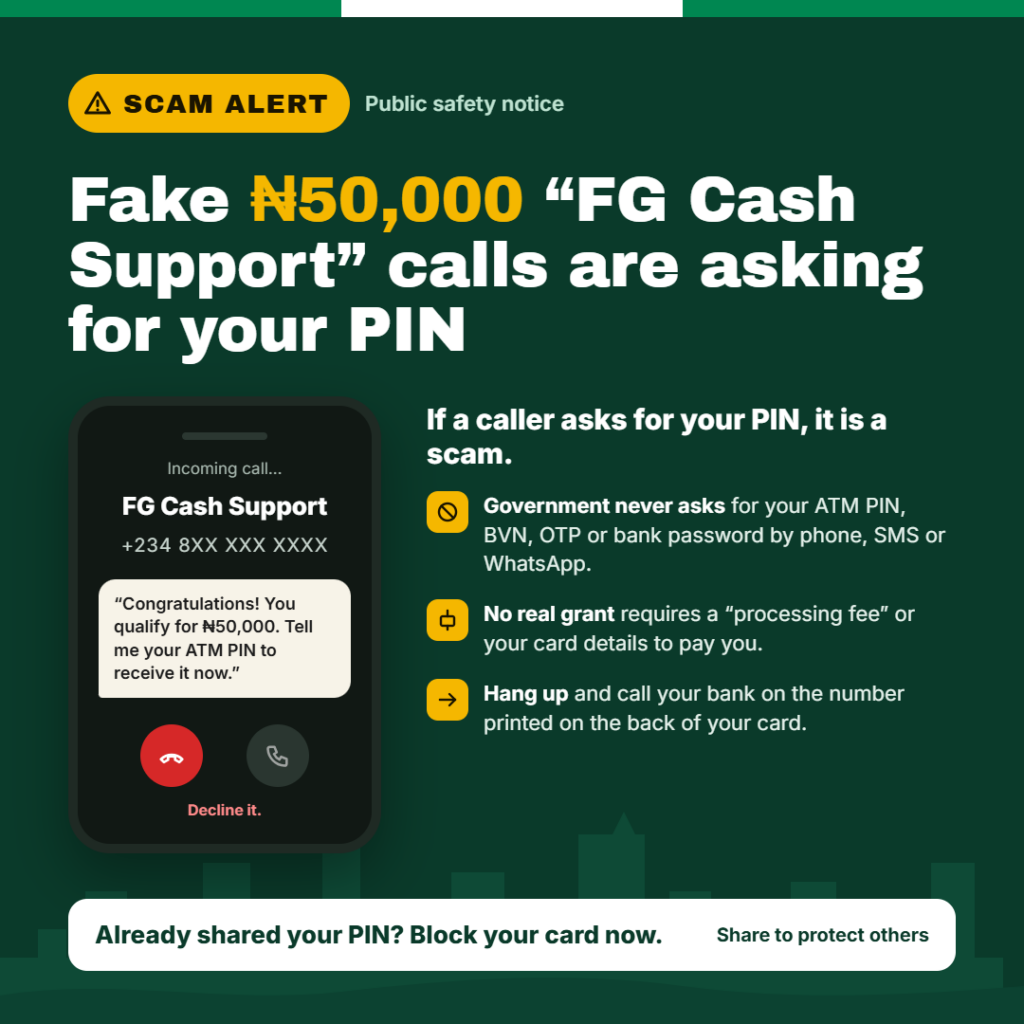
Fraudsters are calling Nigerians and posing as officials of the Federal Government's ₦50,000 NERSI cash support. Real beneficiaries never need to pay, click a link or share a PIN or OTP.

In this article
This alert is for every Nigerian household that might receive the Federal Government’s new ₦50,000 cash support, and for the children, siblings and staff who help older or less tech-savvy relatives use their phones. Within days of the programme being announced, fraudsters began calling people and pretending to be officials who can “help” them get paid. Their real goal is your PIN, your one-time password (OTP) and, through them, your money.
Key takeaways
- Nobody needs to apply, register through an agent or pay any fee to receive the ₦50,000 grant.
- Genuine messages come only from the approved payment providers and only ask you to reply YES or dial your provider’s USSD code.
- No real official, bank or wallet provider will ever ask for your PIN, OTP or password.
- If someone calls offering to help with the payment, end the call.
What the real programme looks like
The cash support is the National Emergency Relief and Stabilisation Intervention (NERSI), implemented by the Federal Ministry of Humanitarian Affairs and Poverty Reduction and announced by the minister on 30 October 2026. According to Vanguard, selected poor and vulnerable households receive a ₦50,000 grant as a direct transfer into a mobile wallet. It is not a loan, it does not need to be repaid, and the full amount should arrive without deductions.
Beneficiaries are chosen from the National Social Register and verified national identity records. People cannot apply on their own or pay to be included. The approved payment providers are ALAT, MoMo, NairaGram, OPay and Moniepoint. The genuine process is:
- A selected person receives an SMS from one of those providers.
- They reply YES to give consent. No payment is made without consent.
- A wallet is opened and linked to their phone number and NIN.
- The ₦50,000 is credited, and can be spent from the wallet or withdrawn at a POS agent or bank.
OPay, for example, says eligible customers will see a pop-up on the app’s home screen, that customers can check using only the official app or its USSD code, and that it does not decide who qualifies.
How the scam works
Step 1: the friendly call
Legit.ng reports that fraudsters are making unsolicited calls while posing as officials of the cash support scheme. They may sound well informed because the programme has been widely reported in the news.
Step 2: building trust
The caller offers to help you access or “process” your payment. They may say your payment is stuck, that you need to be verified, or that they can speed things up. Some offer a phone number for you to call back, which the scammers also control.
Step 3: the request
Once you are relaxed, the caller asks for your PIN, OTP or other banking details. With those, they can take over your bank account or mobile wallet and empty it, including any grant that has just arrived.
Related tricks to watch for
Official guidance also warns against paying anyone to “release” the grant, clicking links in messages about it, and handing your phone to someone else to withdraw the money. The government has clarified that nobody can collect the support on another person’s behalf. A trusted relative may dial the code for someone who struggles, but the beneficiary must always enter their own PIN.
Warning signs
- An unexpected phone call about the ₦50,000 support.
- Any request for your PIN, OTP, password, BVN or card details.
- A message containing a link, or a request to pay a fee, “processing charge” or “registration charge”.
- An SMS from a sender other than ALAT, MoMo, NairaGram, OPay or Moniepoint.
- Pressure to act quickly before your “slot” expires.
- A caller who gives you their own number for follow-up.
How to protect yourself and your family
- End suspicious calls. Do not argue or try to prove anything. Hang up.
- Never share your PIN or OTP, not with agents, officials, bank staff or even close relatives.
- Check only through official channels. Use your provider’s official app or published USSD code, or the NERSI helpline. Look up numbers yourself instead of using any number a caller gives you.
- Talk to older relatives now. Explain that the real process is a text asking them to reply YES, and that anyone calling them about it is likely a fraudster.
- Turn on wallet security. Set a strong PIN that is not a birthday, and switch on transaction alerts in your banking and wallet apps.
What to do if you have been scammed
- Call your bank or wallet provider immediately using the number in its official app or on the back of your card, and ask them to block your account and cards.
- Change your PIN and passwords from a phone you trust.
- Write down the caller’s number, the time of the call and any transaction references.
- Report the incident to your provider’s fraud desk and to the police, and keep copies of every report.
What you should do
Treat every call about the ₦50,000 support as suspicious. The genuine programme needs only your consent by SMS reply and your provider’s own app or USSD code. Share this alert with family members and staff, especially those who are most likely to be selected, so they know that a request for a PIN, OTP or fee is always a scam.
Sources
- Legit.ng: FG cash support scam warning, sharing PIN and OTP with callers not allowed
- Vanguard: N50,000 relief fund, FG explains how beneficiaries will be selected
- Tribune Online: OPay explains how to check eligibility for FG’s N50,000 cash support
- Legit.ng: FG clarifies who can collect its N50,000 cash support on your behalf
Featured image: Photo: “Phone Call” by Georgie Pauwels, CC BY-ND 2.0, via Openverse — source
Have you come across this scam?
Was this article helpful?

adminVerified expert
Cybersecurity Analyst
Federal Capital Territory (Abuja)
Credentials: MCPN, MNCS, IAENG | System Analyst · Web Developer · CEH · CC · CDST
Got expertise to share? Write for us →