Scam Alert: Fake EFCC and NMDPRA Job Offers Demanding Fees
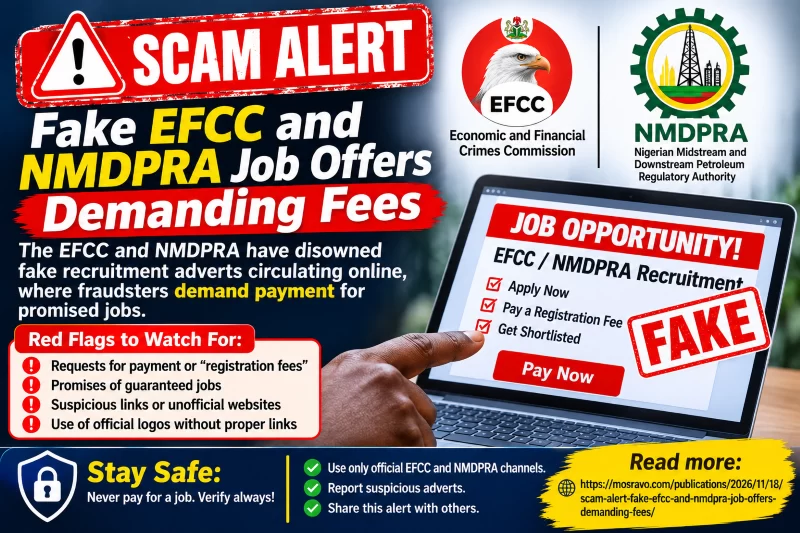
Fraudsters are sending fake EFCC employment emails and NMDPRA job letters that ask applicants to pay small 'processing' fees. Both agencies say recruitment is free. Here is how the scam works and how to stay safe.

In this article
- How the scam works, step by step
- 1. The “you have been selected” message
- 2. A small, urgent payment
- 3. Promises of training and an appointment letter
- 4. Fake letters, flyers and WhatsApp groups
- Warning signs
- How to protect yourself
- For employers and HR teams
- What to do if you have already paid
- Where to report
- What you should do
- Sources
Two federal agencies have warned Nigerians in the past eight days about fake job offers sent in their names. The Economic and Financial Crimes Commission (EFCC) flagged an email that tells applicants they have been “selected” and must pay a small fee. On 19 November 2026, the Nigerian Midstream and Downstream Petroleum Regulatory Authority (NMDPRA) said it is not recruiting at all and that any job letter carrying its name is fake.
This alert is for job seekers, their families, and HR teams and business owners whose staff may be targeted. It explains how this round of the scam works, why the amounts are kept small, and what to do.
How the scam works, step by step
1. The “you have been selected” message
According to the EFCC’s post on its official X account, reported by The Sun, the fake email comes from “EFCC Employment Support”. It greets the reader as “Dear Aspiring Employee” and says their application for the “2026/26 employment session” has been reviewed and approved. Many recipients never applied, but the message is written to feel like good news they were waiting for.
2. A small, urgent payment
The email asks for a “competitive payment” of ₦3,354 into an account belonging to a so-called “revenue collection officer”, and gives only two days to pay. The amount is deliberately low. It feels affordable, it looks like an official processing charge, and few people bother to report losing it. Multiplied across thousands of hopeful applicants, it adds up fast.
3. Promises of training and an appointment letter
Victims are told that once payment is confirmed, documentation and training will follow, with an appointment notification within a week. That delay keeps victims quiet while the fraudsters collect more payments, and it sets up later demands for “training” or “uniform” fees.
4. Fake letters, flyers and WhatsApp groups
The NMDPRA says its impersonators circulate fake recruitment adverts and bogus employment letters through flyers, WhatsApp and Telegram instructions and social media posts. They ask for money described as job placement, processing, registration or screening fees. Nairametrics notes similar warnings this year from FAAN, NUPRC (which dismissed fake and AI-generated employment letters), the Federal Civil Service Commission and the Nigeria Revenue Service.
Warning signs
- Any request for money. The EFCC says its recruitment is absolutely free, with no fees for processing, placement, documentation or training. The NMDPRA says no payment is required for any of its recruitment.
- Payment into a personal account or one named after an “officer” rather than a government revenue channel.
- Tight deadlines such as “pay within two days” to stop you checking.
- Odd wording and dates, like the “2026/26 employment session” in the EFCC fake.
- Offers you never applied for, or offers announced only on WhatsApp, Telegram or flyers.
- Agents or middlemen promising to “help” you get in. The Federal Civil Service Commission says genuine federal recruitment does not involve paid agents.
- Free email addresses or web addresses that are not the agency’s official .gov.ng domain.
How to protect yourself
- Never pay to get a job. Treat any fee request linked to public-sector recruitment as fraud.
- Verify on official channels you find yourself. Type the agency’s website address directly, for example www.nmdpra.gov.ng, and check its verified social media pages. Do not use links or numbers in the message.
- Protect your personal details. Do not send your NIN, BVN, bank login or copies of certificates to unverified contacts. These scams often lead to identity theft as well as loss of money.
- Pause before you act. As UBA’s chief internal auditor put it during the bank’s Fraud Awareness Week this month, fraudsters count on panic and want you to click before you think.
- Talk to someone. Show the message to a family member, friend or HR contact before replying.
For employers and HR teams
- Publish a clear line on your careers page and social accounts: “We never charge fees at any stage of recruitment.”
- Use one official email domain for all recruitment and tell applicants which one it is.
- Remind staff that relatives job-hunting may receive these messages, and share this alert in team groups.
What to do if you have already paid
- Call your bank immediately using the number on your card or the bank’s official app. Ask it to flag the receiving account and attempt to recall the transfer. Speed matters.
- Stop all contact with the scammers and do not pay any “follow-up” fees, even if they threaten to cancel your offer.
- Keep evidence: screenshots of emails, chats, account numbers, phone numbers and payment receipts.
- Change passwords if you shared any login details, and watch your accounts for unfamiliar activity.
Where to report
- NMDPRA impersonation: email authority@nmdpra.gov.ng and report to the nearest police station, as the authority advises.
- EFCC impersonation: report through the EFCC’s official website and verified social media channels.
- Your bank: report the receiving account so it can be investigated.
What you should do
Share this alert with anyone in your family or team who is job hunting. The rule is simple: real government recruitment does not ask you to pay. If a message says you have been selected and asks for money, it is a scam, however official the logo looks.
Sources
Have you come across this scam?
Was this article helpful?

adminVerified expert
Cybersecurity Analyst
Federal Capital Territory (Abuja)
Credentials: MCPN, MNCS, IAENG | System Analyst · Web Developer · CEH · CC · CDST
Got expertise to share? Write for us →