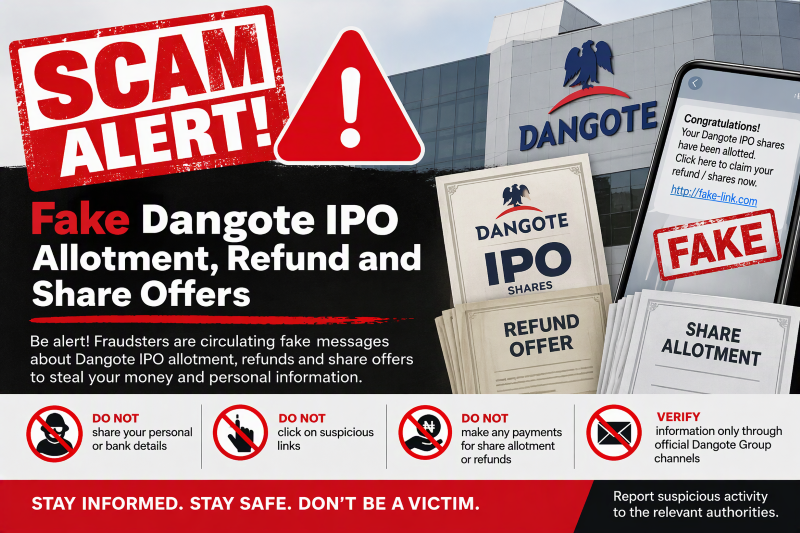
Scam Alert: Fake Dangote IPO Allotment, Refund and Share Offers
The Dangote refinery public offer has closed, but scammers are still selling 'late' slots, 'pre-listing' shares and fake refund services. Learn how the tricks work and how to protect your money.

In this article
- Key takeaways
- Background: the offer and what happens next
- How the scams work
- 1. “Late” or “special” allocation offers
- 2. “Pre-listing” discount shares
- 3. Fake allotment checkers
- 4. Refund “processing” fees
- 5. Impersonated registrars and brokers
- 6. Unregistered platforms and “guaranteed profit” groups
- Warning signs
- How to protect yourself
- What to do if you have been scammed
- What you should do
- Sources
The Dangote Petroleum Refinery public offer drew huge interest from Nigerians at home and abroad. The offer is now closed, but the excitement has not faded, and fraudsters are using it. This alert is for anyone who applied for shares, anyone who missed out and still wants in, and employers whose staff may be targeted through WhatsApp and social media.
Key takeaways
- The official offer website says the public offer closed on 27 October 2026 and applications are being checked. Nobody can sell you “late” or “special” slots at the offer price.
- Real refunds for money not allotted go back through the channel you applied with. You should never pay a fee to receive a refund or check your allotment.
- The SEC has repeatedly warned against unauthorised channels for this offer and in October publicly disowned a platform that advertised access to it.
- Never share your BVN, PIN, OTP or banking login on a link sent to you about the IPO.
Background: the offer and what happens next
The offer of 4.1 billion ordinary shares at ₦525 each opened on 14 September 2026, aiming to raise about ₦2.15 trillion, with a minimum application of 10 shares. Approved channels included banks, stockbrokers, fintech platforms, mobile money operators and the Nigerian Exchange’s NGX Invest portal. The official site now shows that the offer closed on 27 October.
After the close, applications are verified, a basis of allotment goes to the SEC for clearance, results are announced, refunds are paid and the shares are listed on the NGX. Reported timelines suggest these steps run through November into early December, but the dates have not been officially confirmed. That gap between closing and listing is exactly where scammers operate, because many people are waiting for news.
How the scams work
1. “Late” or “special” allocation offers
Someone on WhatsApp, Telegram, Facebook or TikTok claims they can still get you shares at ₦525, often through a “relationship” with a bank or broker. The offer is closed. Any payment you make goes straight to the fraudster.
2. “Pre-listing” discount shares
Sellers advertise shares below the offer price before trading begins, promising quick profit on listing day. There is no legitimate pre-listing retail market for these shares.
3. Fake allotment checkers
A link promises to show how many shares you were allotted, then asks for your BVN, card details or internet banking login. The goal is to take over your account, not to show you any results.
4. Refund “processing” fees
Callers or messages say your unallotted money is ready but must be “released” by paying a small fee first. Genuine refunds carry no fee and return through the bank, broker or app you used.
5. Impersonated registrars and brokers
Fraudsters pose as the registrar, your stockbroker or your bank and ask you to “update your details” through a link before shares can be credited.
6. Unregistered platforms and “guaranteed profit” groups
On 9 October the SEC said WayvePay, described in reports as the digital platform of a microfinance bank, was not registered to solicit investments from the public, after it advertised access to the offer. The SEC warned that dealing with unregistered entities exposes investors to fraud and loss. Paid groups promising guaranteed listing-day gains follow the same pattern the SEC has flagged in its wider warnings about Ponzi-style schemes on social media.
Warning signs
- Any offer to buy shares at or below ₦525 now that the offer has closed.
- Any request for money to check an allotment or receive a refund.
- Links sent through WhatsApp, SMS or social media asking for your BVN, PIN, OTP or login.
- Promises of guaranteed allotment, guaranteed profit or “insider” access.
- Pressure to act quickly before a “deadline”.
- Payment into a personal account, or to a platform you cannot find on the SEC’s register.
How to protect yourself
- Check your allotment only through the bank, broker or app you applied with, or through official announcements from the issuer and the registrar.
- Verify any broker or platform on the SEC’s official portals at sec.gov.ng before sending money. The SEC notes that a company or social media page existing does not mean it is authorised.
- Type official web addresses yourself instead of clicking links in messages.
- Wait for listing. Once the shares trade on the NGX, buy only through a licensed stockbroker, and remember the price may be above or below ₦525.
- Talk to staff and family. Many victims are first-time investors who joined through friends’ WhatsApp groups.
What to do if you have been scammed
- Call your bank’s fraud desk immediately and ask them to try to stop or recall the transfer.
- Change your banking passwords and PINs if you entered them on any link, and check for new devices on your accounts.
- Keep screenshots, phone numbers, account numbers and chat histories.
- Report to the Nigeria Police Force National Cybercrime Centre, the EFCC and the SEC.
- Warn your contacts, since scammers often reuse the same groups and pages.
What you should do
If you applied, be patient and rely only on your original application channel for allotment and refund updates. If you missed the offer, ignore anyone selling “late” access and wait for the shares to list on the NGX. Pay nobody for refunds or allotment checks, and never give out your BVN, PIN or OTP.
Sources
- Dangote Petroleum Refinery Public Offer: offer closed notice
- Legit.ng: SEC warns investors against fraud schemes tied to Dangote Refinery IPO
- Daily Times: SEC flags unregistered investment channel
- Profiled Nigeria: Dangote IPO closes: allotment, refunds, listing and scams to avoid
- Arise News: SEC warns against illegal Ponzi schemes on social media
Featured image: Photo: “Pioneer Oil Refinery” by tkksummers, CC BY-SA 2.0, via Openverse — source
Have you come across this scam?
Was this article helpful?

adminVerified expert
Cybersecurity Analyst
Federal Capital Territory (Abuja)
Credentials: MCPN, MNCS, IAENG | System Analyst · Web Developer · CEH · CC · CDST
Got expertise to share? Write for us →